
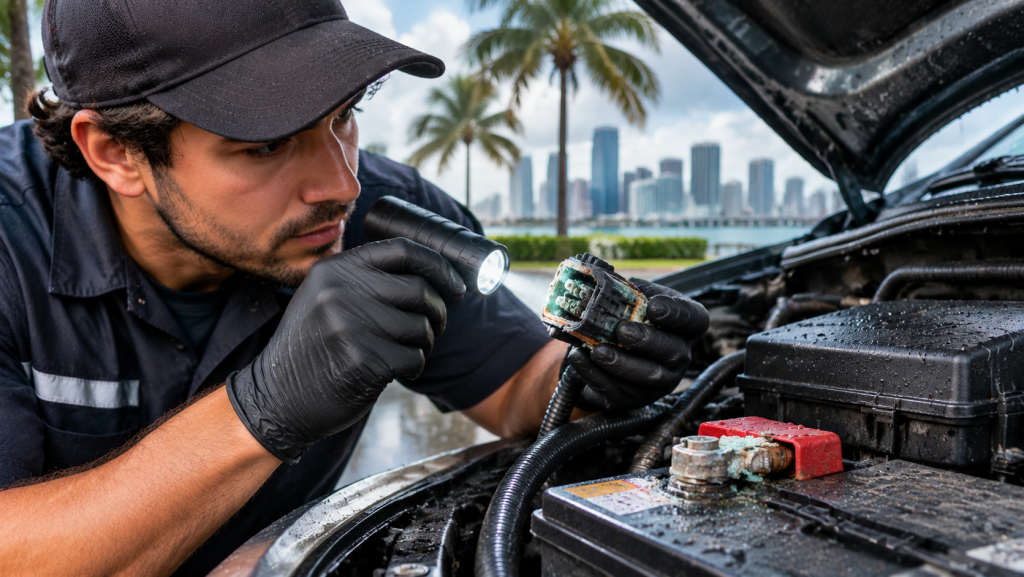
A dashboard light that flickers on and off, a window that will not go up, a radio that cuts out or a car that starts fine one day and clicks the next. Electrical glitches like these are some of the most frustrating problems a car can have, because they come and go and seem to have no pattern. In a humid place like Miami, there is often a pattern, and moisture is at the center of it. Water in the air finds its way into connectors, fuse boxes, grounds and wiring, and over time it causes corrosion that interferes with the flow of electricity. This guide explains how humid air causes electrical problems, how to spot the early signs, what you can check yourself, what to leave to a professional and how to slow the damage. If you are searching for car electrical repair in Miami, this overview will help you understand what may be happening.
Why Humidity Is Hard on Car Electronics
Modern cars are packed with electronics. Computers, sensors, lighting, entertainment, safety systems and dozens of motors all depend on clean electrical connections. Those connections are made of metal, and metal reacts with moisture and oxygen. Add warm temperatures, which speed up chemical reactions, and Miami’s air becomes a constant challenge for electrical parts.
- Moisture in connectors. Even a sealed connector can let humid air creep in over time as seals age.
- Corrosion on metal contacts. Corrosion forms a layer that resists electricity, which causes weak or intermittent connections.
- Salt in the air. Coastal air carries salt, which makes moisture more conductive and corrosion faster.
- Condensation. When temperatures change, water can form inside housings, light assemblies and control modules.
- Heat cycles. Repeated heating and cooling can open tiny gaps in seals and pull moisture inside.
- Wet carpets and leaks. Water that gets inside the cabin can reach wiring and modules under the seats and dash.
How Corroded Wiring and Connections Cause Glitches
Electricity needs a clean path. When corrosion builds up on a terminal, a connector pin, a ground point or the inside of a wire, the path gets narrower. Some current still passes, but not enough, or not consistently. That can cause strange symptoms that depend on temperature, vibration and moisture. A part that works fine on a dry morning may fail after a rainy afternoon.
Water can also create unintended paths. Moisture between two connector pins can cause a small leak of current that confuses a sensor or a computer. That kind of fault is hard to pin down and can send technicians chasing a part that is actually fine.
Common Signs of Humidity Related Electrical Trouble
- Slow or weak starting, or a car that clicks without cranking. Corroded battery terminals and ground connections are frequent causes.
- Flickering or dim lights, including headlights, interior lights and dashboard lights.
- Warning lights that come on and go away, such as the check engine, ABS, airbag or battery light.
- Power windows, locks or mirrors that work sometimes.
- Radio or screen glitches, including random restarts or loss of sound.
- Wipers, fans or blowers that run erratically.
- A key fob or push button start that is unreliable.
- Dashboard gauges that jump or misreport.
- A burning or musty smell, or visible moisture inside light housings.
- Blown fuses that keep coming back.
- Sensors that report odd readings, which can lead to rough running or poor fuel economy.
Many of these can have other causes, such as a weak battery, a failing alternator or a defective part, so a proper diagnosis matters.
Where Corrosion Likes to Hide
- Battery terminals and cables. A white, blue or green crust is easy to spot and a classic sign.
- Ground straps and ground points. These connect the electrical system to the car body, and a poor ground can cause all sorts of odd behavior.
- Fuse and relay boxes. Moisture can get in and corrode the contacts.
- Connectors near the wheels and under the car, such as those for ABS and wheel speed sensors, which are exposed to water and road spray.
- Connectors in the engine bay, for sensors, injectors and ignition parts.
- Lighting assemblies, where seals can fail and let water in.
- Under the carpet and seats, where leaks can reach modules and harnesses.
- Trunk and tailgate connections, where water collects around seals.
What You Can Safely Check Yourself
Some simple checks are safe for most owners, as long as you take care.
- Look at the battery terminals for corrosion and loose connections, with the car off. Wear gloves and eye protection, since battery corrosion can irritate skin and the battery contains acid.
- Check for dampness under floor mats, in the trunk and around door and window seals.
- Notice patterns. Do glitches happen after rain, a car wash or a humid morning? Jot it down for the technician.
- Check the fuses listed in your owner’s manual. If a fuse is blown, replace it only with one of the same rating. Never use a higher rated fuse, since that can create a fire risk.
- Look for water in the headlights or tail lights.
Leave deeper work to a professional. Electrical systems can store energy, and airbag circuits and high voltage systems on hybrid and electric vehicles are dangerous to work on. If you are unsure, do not try it yourself.
Safety Notes
- Do not spray water or cleaning liquids on electrical connections or modules.
- Do not ignore a burning smell or smoke. Stop driving, turn off the car and get help. Electrical faults can start fires.
- Do not jump start or charge a battery that looks cracked, swollen or leaking.
- Do not disable or ignore warning lights related to brakes, airbags or steering.
- Follow your owner’s manual for fuse locations, battery procedures and what each warning light means.
Storms, Flooding and Electrical Damage
Miami’s storm season adds another risk. If water gets into the cabin or engine bay, electrical components can be damaged, and the problems may show up weeks later as corrosion spreads. A car that has been in standing water should not be started until it has been inspected, because power can damage parts that might otherwise have been saved. Our hurricane season car checklist lists what to check before the season, and our article on hurricane season prep and getting your car ready in Miami explains how to prepare for storms and what to do afterward.
How a Technician Finds Electrical Problems
- Listening to the history. When did it start, what makes it better or worse, and does it happen after rain?
- A code scan, to see what the car’s computers have stored.
- A visual inspection of connectors, grounds, fuse boxes and wiring for corrosion, damage and moisture.
- Testing with a multimeter and other tools, to check voltage, resistance and continuity.
- A battery and charging system test.
- Wiggling and flexing wiring while monitoring the circuit, to find an intermittent fault.
- Checking for water entry points, such as seals, drains and sunroofs.
Typical Repairs
- Cleaning corroded terminals and connectors, and applying protection to keep moisture out.
- Replacing damaged terminals, connectors or sections of wiring.
- Repairing or replacing ground connections.
- Replacing a battery or cables that are worn or corroded.
- Replacing failed relays, switches or modules, when testing shows they are the cause.
- Fixing leaks so water stops getting in.
- Drying out affected areas, such as carpets and padding.
Ask the technician to explain the root cause, not only the part replaced. If moisture is getting in and the leak is not fixed, the problem is likely to return.
Can a Mobile Mechanic Handle Electrical Repairs?
Often, yes. A mobile mechanic can come to your home or workplace in Miami, scan for codes, test the battery and charging system, inspect connectors and grounds and carry out many electrical repairs, such as cleaning corrosion, replacing a battery or a connector and fixing a wiring fault. Some jobs, such as tracing wiring deep inside the dash, repairing water damaged modules or chasing a stubborn intermittent fault, can take more time or special equipment, and may be better suited to a shop. A good technician will tell you honestly what can be done where you are.
How to Protect Your Car From Humidity
- Keep battery terminals clean and tight, and have them inspected during routine service.
- Fix leaks promptly, including worn door seals, sunroof drains and cowl drains.
- Dry wet carpets and mats, and do not leave water sitting inside the cabin.
- Park in a garage or covered spot when you can.
- Rinse the underside of the car if you drive near the coast, and avoid pressure washing electrical connectors in the engine bay.
- Do not ignore small glitches. Early repairs are simpler than waiting for a failure.
- Have the electrical system checked before storm season.
- Use only quality parts and the right fuses.
Quick Summary
- Humid, salty air causes corrosion in connectors, grounds, fuse boxes and wiring.
- Symptoms include slow starts, flickering lights, glitchy electronics and warning lights that come and go.
- Check battery terminals and dampness, but leave deeper work to a professional.
- Stop driving if you smell burning or see smoke, and do not start a flooded car.
- Many repairs can be done at your home, while some need a shop.
Catching moisture damage early keeps small glitches from turning into breakdowns. If you would like help, visit the Mobile Mechanic Pros of Miami homepage to learn more, or contact us to schedule a visit.